

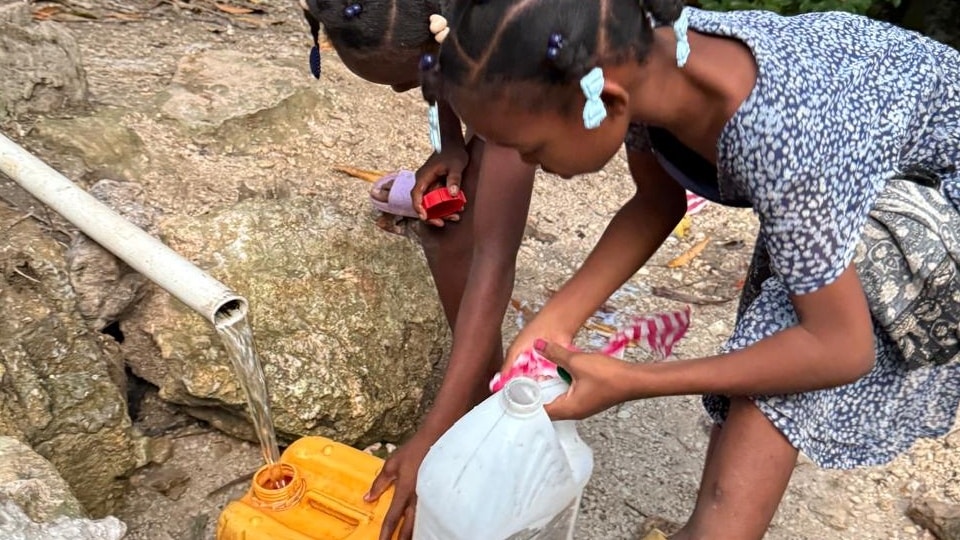
In the mountains above the Matènwa community on Lagonav Island, a place called Little Spring is a lifeline.
Every day, families depend on this spring for the water they need to drink, cook, wash, and care for their homes. But getting that water is not simple.
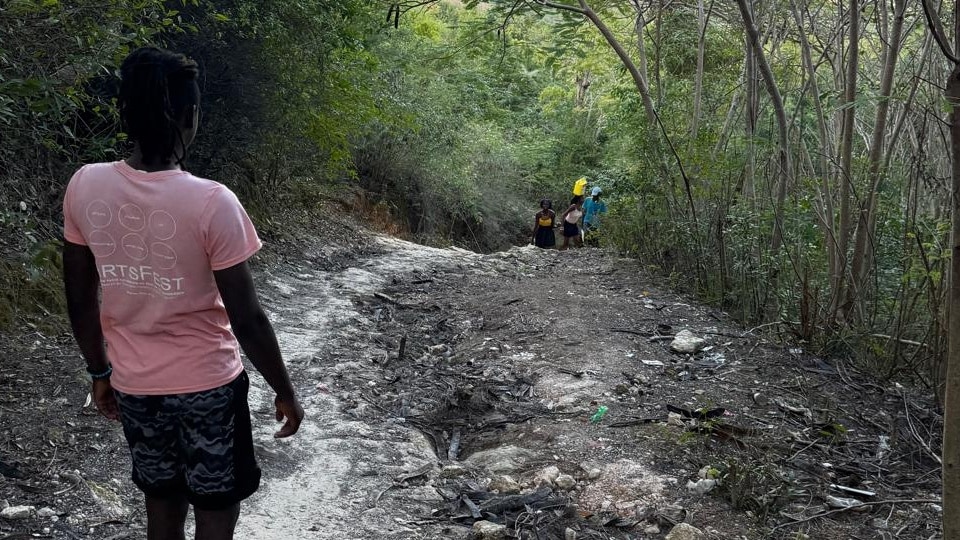
People must climb down a steep, rocky ravine, fill containers holding up to seven gallons, and carry them back uphill. The trip can take 30 minutes each way — and during drought periods, families from higher elevations may walk as long as two hours one way.
The burden falls most heavily on women and girls, who are primarily responsible for collecting water. About one-third of the households in this area are led by women, making reliable access to water especially important for family stability and safety. (Photo: Local women and girls walk back up the steep and rocky path after collecting water from the spring.)
What we hope to do
If our recent grant application is approved, Friends of Matènwa and the Matènwa Community Learning Center (MCLC) will install a solar-powered water pumping system to bring water from Little Spring up to road level.
The project would:
- Serve approximately 800 people each day across four rural communities
- Pump water uphill using nine photovoltaic solar panels and a submersible solar pump
- Store water in a 1,600-gallon roadside tank
- Provide access through two water kiosks at road level
This simple change would eliminate the dangerous daily climbs into the ravine and save hours of labor for families.
The location at road level would also allow trucks to transport water to surrounding communities during severe drought — an increasingly important safeguard as climate conditions become more unpredictable.
Why solar matters
This system will operate entirely on solar power.
That means:
- No fuel costs
- No dependence on the electrical grid
- Reliable operation in a remote rural area
- A long-term, climate-resilient solution
The system is designed to produce about 1,600 gallons of water per day, enough to meet daily household needs while keeping operating costs low.
Built by the community
Like all MCLC initiatives, this project begins with the community itself.
Local residents identified the need and requested support in bringing water up from the spring. If the project moves forward, community members will organize volunteer work teams to dig the pipeline trenches and prepare the construction site — a significant in-kind contribution.
After installation, a community water committee will manage day-to-day operations, oversee maintenance, and ensure fair access for all households.
This community ownership is what makes projects like this sustainable over the long term.
Building on what works
MCLC and its partners have nearly three decades of experience implementing community-led projects on Lagonav. Existing solar systems already support the school campus and pump water for gardens and local use, improving food production, reforestation, and household stability.
The Little Spring project builds on that proven experience — and on the trust that has been developed between MCLC and the surrounding communities over many years.
What reliable water makes possible
When water is easier to access:
- Physical strain and safety risks are reduced
- Children have more time for school
- Women have more time for income-generating work and family care
- Household health and sanitation improve
- Communities are better prepared for drought
In short, reliable water creates the conditions for stability and opportunity.
Looking ahead
We expect to learn later this year whether this project will be funded.
If approved, the work will move forward with local labor, experienced engineering support, and full community involvement — bringing a long-term, clean-energy water solution to four communities that need it.
At MCLC, progress often comes one practical step at a time.
Reliable water from Little Spring would be one of those steps — making daily life safer, easier, and more secure for hundreds of families on Lagonav.


