By Brian Stevens
From mid-January to early February of this year, I spent three weeks living and working in Matènwa. Most days, you could find me in the elementary school office, which looks out onto a large, round patio. This patio is the heart of the campus—a gathering space for teacher training, a thoroughfare for students, and the spot where much of the daily life of the school unfolds.
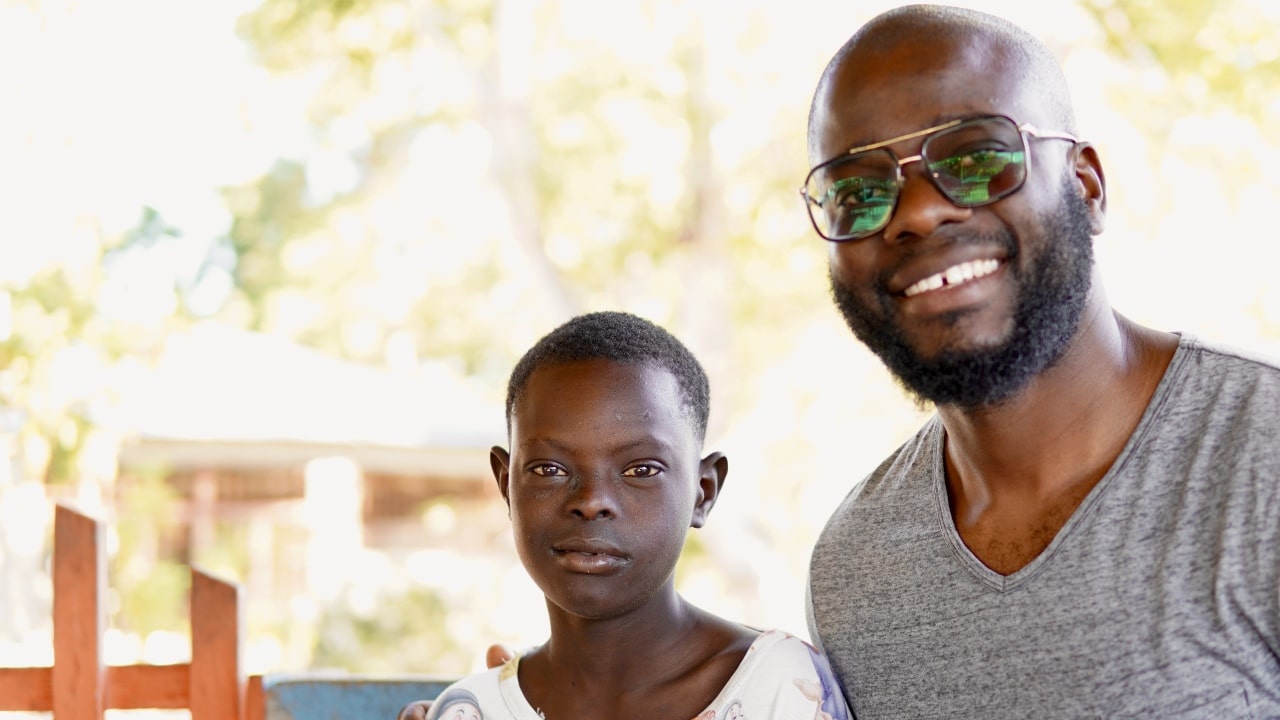
This is where my colleague Williamson Jacques, known to everyone as Yaya, usually works. Yaya is a steady, focused bridge between the Matènwa Community Learning Center (MCLC) and the Friends of Matènwa, and he leads our university scholarship program.
Often sitting right beside Yaya is Jules, nicknamed "Bri Sapat." In Haiti, nicknames are common and used with deep affection—this one refers to a beloved comedian.
After his mother passed away recently, Jules—who has Down Syndrome—found comfort in moving through the campus throughout the day rather than staying confined to a single classroom. While MCLC doesn't have a formal "special education" department, it has something I came to appreciate more each day: a culture of radical welcome.
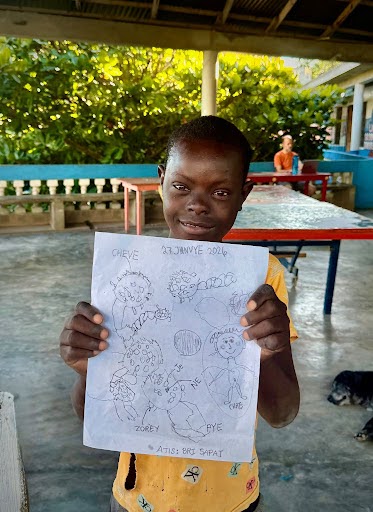
Jules shows off his drawing to Chris.
Most mornings, Jules chooses to sit next to Yaya, watching him work and asking questions. I often saw them sharing a lunch or just sitting in a comfortable, quiet companionship. There was no fuss, no dramatic intervention—just two people sharing a space.
This pattern of inclusion follows Jules wherever he wanders on campus. One day, I saw him drawing with Chris (and her dog, Boy). Another afternoon, I found him in the school garden with Elijene, one of our agriculture technicians, learning to tend the rows of cabbage and greens. In every instance, he was simply included in whatever was happening.
You see this culture in a hundred small, everyday ways: someone making space at a table, a teacher pausing to answer a question, or a student inviting a peer to join a game. It is a regular pattern of attention and care that shapes the entire atmosphere of the school.
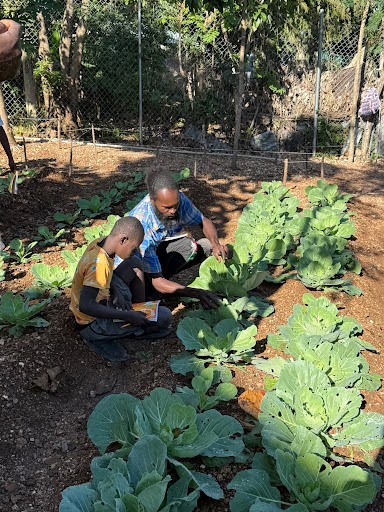
Jules alongside Elijene, one of MCLC's agronomists, in the school garden.
During my time in Matènwa, I saw exceptional teaching and creative classrooms. But what stayed with me most were these quiet moments of recognition. It’s the way no one is treated as an "other," and the way belonging is woven into the very fabric of how the community works.
Yaya and his wife recently welcomed a newborn daughter in Port-au-Prince. He is currently working toward buying a small piece of land in Matènwa to build a home and move his family there. After my three weeks on the mountain, I understand exactly why he wants to raise his daughter in this community.
What makes Matènwa special isn’t a single program or a specific pedagogical approach. It’s the culture the community creates together, day after day—a place where everyone is known, everyone is seen, and everyone has a place at the table.