Global Center for the Development of the Whole Child.
How do you build a school? For Chris Low, it started with a simple pencil.
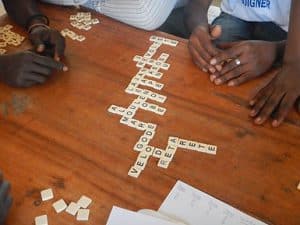
Chris Low used to teach at a bilingual school —Haitian Creole and English— in the Cambridge Public School Department (CPSD). Given the school’s direct connection to Haitian culture and history, she always sought out opportunities to learn more about the country. However, the more she learned about Haiti, the more she could not understand why there was so much poverty and desired a way to make a difference in this community that she loved. It wasn’t until she visited the Island of Lagonav, Haiti and began to engage in an adult literacy program (run by a community association, AAPLAG, and funded by Beyond Borders) that she started to understand more about the roots of poverty in Haiti. What she saw astounded her. She saw adults working to achieve literacy in their mother tongue, Haitian Creole, a direct result of the remnants of a colonial past that made French the official language of instruction in schools despite most students and teachers having little to no fluency in the language. Haiti’s colonial past continues to contribute to a fragile education system that leaves students floundering in classrooms where they are taught in a language they frequently do not understand.
Struck by the reality of Haitian schools and their impact on the life trajectory of their students, Chris considered what she could do. She took a one year leave of absence…
Click here to see the full article on Global Center for the Development of the Whole Child.