Community Outreach
By supporting MCLC, you help students and families care for elders, honor their culture, safeguard the land, and build lasting food security.
Supporting Elders With Care and Dignity
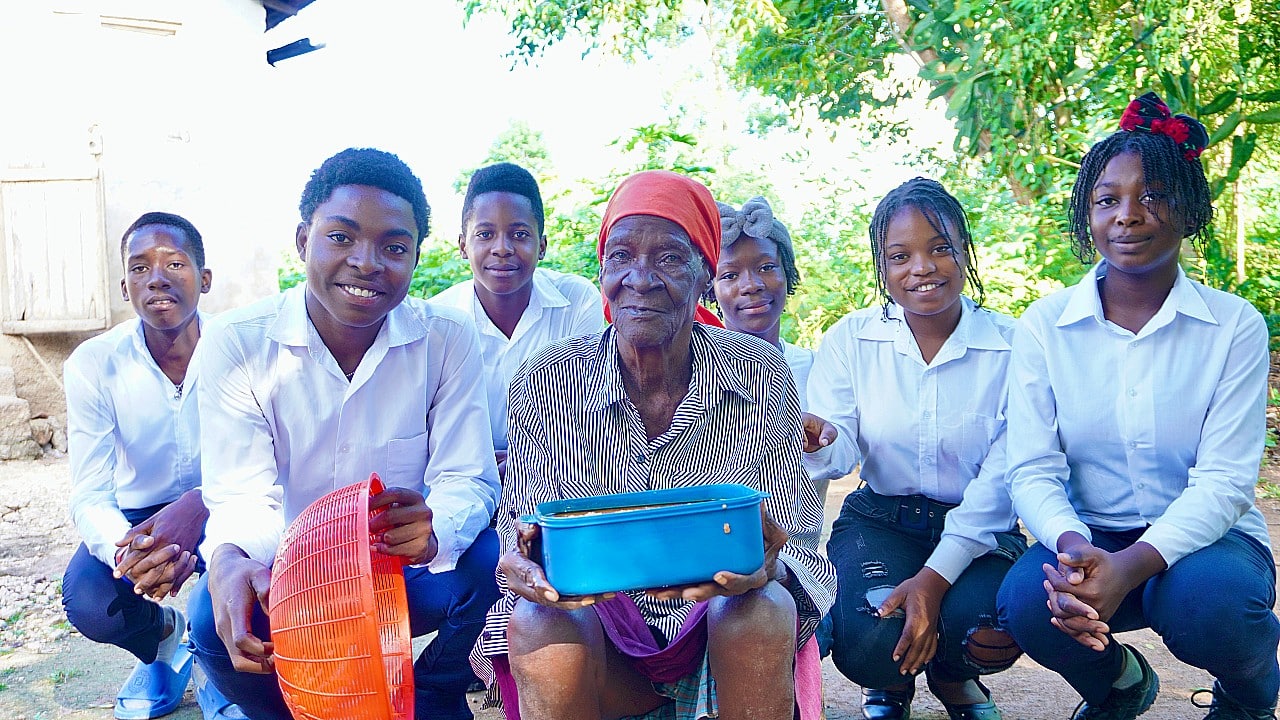
Every morning, elders in the community are welcomed to share in the school’s breakfast—no questions, no stigma, just solidarity.
For those who cannot travel to the school, the ninth-grade class committee delivers meals directly to their homes, ensuring no elders are left out.
Food is nourishment, but here it is also belonging: a reminder that every generation matters.
Weekend Food Kits: Feeding Families Beyond the Classroom
School meals fuel learning—but hunger doesn’t pause on weekends.
With support from Friends of Matènwa, students take home food kits to share with their families, helping ensure children and caregivers have enough to eat when school is closed.
When resources allow, the goal is to distribute 200 food kits each month.
“Parents felt seen. Students felt supported. And we all felt your compassion.” — Abner Sauveur, MCLC Co-Founder
This effort strengthens food security, family well-being, and students’ ability to learn.
Bottled Housing Initiative: Building Sustainably, Reducing Waste
On Lagonav, housing and community buildings are difficult and expensive to construct. Materials cost more because they must be transported long distances, often over unpaved roads. At the same time, plastic waste is piling up across the island with no local recycling systems and limited waste collection—leading many communities to burn trash, releasing toxic fumes.
The Bottled Housing Initiative connects these challenges to create a powerful, local solution.
How It Works
Using eco-bricks—plastic bottles densely packed with sand or other waste—communities can build durable structures using materials already on hand. Bottles are cemented together and finished with earth or concrete, turning waste into building blocks.
Who Benefits
The program prioritizes vulnerable families including elders, young mothers, and people with disabilities—those least able to afford safe housing or withstand climate stress.
Why It Matters
This approach:
- reduces plastic pollution
- lowers construction costs
- supports local labor and skills
- creates long-lasting community infrastructure
What once polluted the environment becomes a foundation for stability and dignity.
Honoring Haiti’s Flag Day: Pride, History, and Celebration
Every May 18, MCLC students and teachers lead a vibrant community celebration of Haitian Flag Day—a moment to honor the country’s history of resistance, unity, and liberation.
The celebration features music, dancing, student performances, and a student-led band. Teachers facilitate conversations about the meaning of the Haitian flag and what it means to carry forward the legacy of the ancestors who fought for independence.
Flag Day is more than an event—it is education rooted in culture, identity, and national pride.
Watch: MCLC 2025 Flag Day Community Celebration
Planting for the Future: Community Agriculture Days
Each spring, communities across Haiti celebrate agriculture with pride, music, food, and planting. MCLC students join by planting fruit trees—like avocado and tamarind—that will:
- nourish families
- prevent erosion
- provide shade
- strengthen food security
- generate future income
Learning and farming grow together—each reinforcing the other.


Emergency Committee
When the unexpected happens—storms, displacement, health emergencies, sudden crises—the MCLC Emergency Committee mobilizes quickly to support families in need. The Committee identifies urgent priorities, coordinates communication across the community, and ensures that resources reach people when they need them most.
As part of this work, the Committee has supported the construction of seven new homes for families facing severe hardship, with an eighth underway but paused due to limited funding. These homes were built in four communities:
-
Matènwa (2)
-
Masikren (2)
-
Mango / Palma area (2)
-
Plèn Mapou (1)
The construction process itself strengthened the local economy—providing paid work for masons, carpenters, and truck drivers, and creating income opportunities for farmers who supplied stone and sand. This community-driven model ensures that emergency support not only meets immediate needs but also builds long-term resilience for families across Lagonav.
A Community Growing Together
Each of these initiatives reflects a single, shared belief:
Education is not separate from life. It strengthens communities because it grows from them.
MCLC is not just teaching children—it is cultivating leaders who care for their neighbors, their land, and their future.