This is my third week on Lagonav Island, and yesterday I got to see—up close—the Hub School initiative, a next step in spreading the Matènwa approach to teaching across this island.
In 2020, after years of training teachers in nonviolent, child-centered, Haitian Creole–based education, leaders at the Matènwa Community Learning Center began asking a practical question:
How does strong teaching spread without depending on one central training team forever? What if knowledge didn’t only flow outward—but moved laterally, from school to school, community to community?
That’s the idea behind Hub Schools.
Selected by MCLC from among schools that have completed the two-year Matènwa training, Hub Schools are implementing the approach with consistency.

The Matènwa way: a nonviolent, mother tongue, participatory approach; inspiring student curiosity, creativity, and leadership.
Each Hub School receives 20,000 Haitian gourdes from MCLC, about $150 USD, to help with teacher stipends and basic materials—so they can remain stable while serving as learning centers for other schools in their zone.
It’s not a large sum, but it signals partnership and shared responsibility.
As Vana Edmond, Director of the Institute for Learning since 2022, put it to me: “The Hub School initiative is about building a structure that lets good practice travel.”
MCLC would like to expand the Hub School initiative—but for now, the means are limited. Still, what’s already happening shows what’s possible.
Yesterday, I visited one of these Hub Schools: École Communautaire Les Visionnaires de Nan Kafe—the Community School of the Visionaries of Nan Kafe, at the invitation of Lucso Alfred, a co-founder of the hub school. He’s also an agronomist and professor at the Matènwa Community Learning Center.
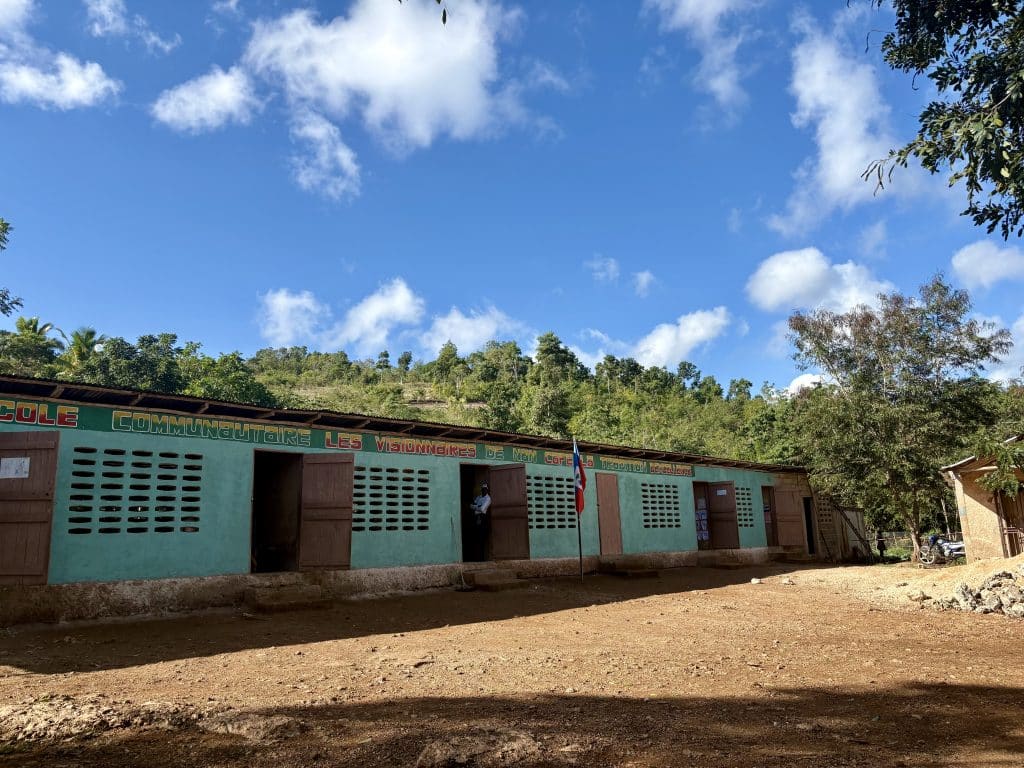
The Community School of the Visionaries of Nan Kafe, a hub school in the Matènwa school network.
Getting there meant a slow motorcycle ride over rocky roads, just over two miles from Matènwa. I had visited this school once before, about ten years ago, and I was curious to see how it had evolved.
The school now serves 91 students—the largest enrollment it has ever had—driven in part by families who fled violence and instability on the mainland.
From the moment I stepped inside, I understood why this school is a Matènwa Hub.
Students sat in circles. Learning objectives and daily schedules were posted clearly. Attendance sheets hung by each classroom door, visible to everyone. And the walls—so often bare in traditional schools—were alive with student work in geography, math, and science.
Girls and boys participated equally. They shared leadership. They spoke with confidence. They listened closely. Nothing felt staged or rushed. It felt steady. Normal. As if this is simply how classrooms should work at every school.
One of the teachers is a graduate of the Matènwa Community Learning Center. Watching her teach with clarity and calm made the whole idea behind Hub Schools click. The training didn’t stay at MCLC—it’s now part of how she teaches, day in and day out, with her own students.
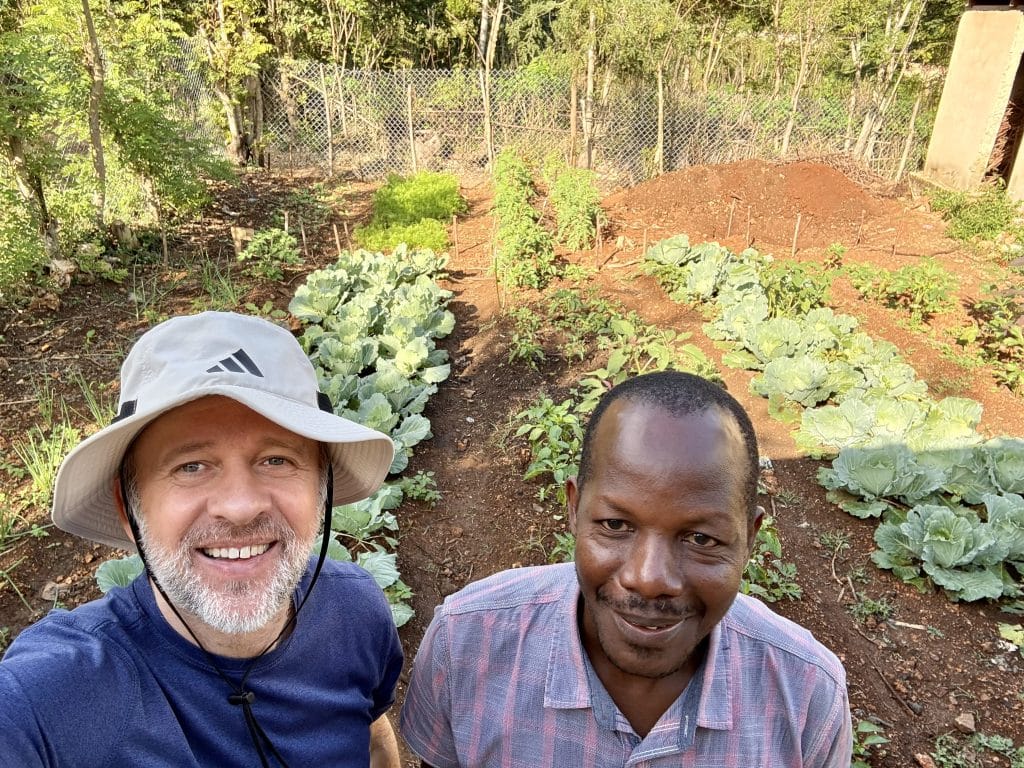
Lucso Alfred, a co-founder of the school, shows me around the school garden.
Outside, the school garden is a hands-on classroom too. Each class is responsible for something growing there. I saw cabbage, carrots, okra, sweet peppers, tomatoes, and chives.
One plant piqued my curiosity: eggplant grafted onto turkey berry, another kind of eggplant. The two plants are joined so the strength of one supports the growth of the other. It’s practical, creative, and, to a non-gardener like me, brilliant!

When the garden is ready, the harvest is used both to help feed students and to be sold in the local market, generating income to support the school. They’re also planning to start a school nursery. Like the classroom curriculum, the garden connects learning directly to daily life on Lagonav Island.
Hub Schools matter because they create places like this where strong teaching practice can be seen, shared, and learned from—not as theory, but as lived experience.
The goal isn’t to identify a few stellar schools. It’s to build a wheel-and-spokes model across Lagonav. The island is divided into four zones, with one Hub School in each—an anchor school educators can return to, learn from, and build around. The Ministry of Education has a school inspector in each of the four zones who works closely with each Hub School and MCLC.
These hubs also model any new curriculum that MCLC pilots and later adopts, so practice travels through relationship and demonstration, not decree.
Standing in Nan Kafe today, it felt clear what the world has to learn from schools like this: education works best when students are treated as capable, when learning is visible and hands-on, when schools are woven into the life of their community, and when educators are trusted to lead.
This is how the Matènwa approach that people like you are making possible travels across Lagonav—school by school, teacher by teacher—through relationships, practice, and shared vision.
I left Nan Kafe grateful, encouraged, and eager to see what becomes of that grafted eggplant!
In gratitude,

Brian Stevens
Deputy Director | Friends of Matènwa