Haiti has lost over 98% of its original forest cover. For those of us on the island of Lagonav, that’s not an abstract environmental statistic—it’s a direct threat to our survival. When the heavy rains hit, the unprotected topsoil simply washes away, taking the nutrients our crops need and leaving behind barren rock.
But in Matènwa we aren’t waiting for a rescue. We are digging in.
We are thrilled to announce that the Eurofins Foundation has awarded the Matènwa Community Learning Center (MCLC) a significant grant to scale up our terracing work. This isn't just about farming; it’s about food sovereignty.

Why it matters—now and always
With the roads on the mainland often blocked by insecurity, Lagonav has been physically cut off from the usual supply chains. But this crisis hasn't changed our mission—it has only confirmed it. As our parents and students recently concluded in our community workshops: Lagonav is rich, and our path to prosperity starts with valuing our own products.
Relying on the gran tè (mainland) for food we can grow ourselves isn't just a logistical risk; it’s an economic one that keeps us dependent on expensive imports. The ability to feed ourselves from our own soil isn't a "nice-to-have" project or a temporary fix for a crisis. It is a lifeline and a statement of independence. We believe that true wealth means growing what we need in our own backyard, because we have the soil, the seeds, and the skill to do it.

The Strategy: Turning "Steps" into Sustenance
Terracing is a brilliant, age-old method of turning steep, unusable hillsides into productive "steps." These levels slow down water runoff, allowing it to soak into the earth rather than stripping the soil away.
With the support of the Eurofins Foundation, we are:
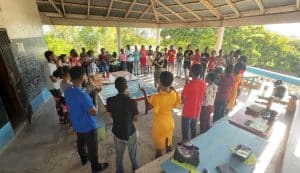
- Training 30 Communities: We aren’t just doing this at the school. Our agriculture technicians are training leaders across 30 different sites on Lagonav to implement these techniques.
- Growing Real Food: These terraces aren't just for show. We are planting high-yield, nutrient-dense crops like cabbage, spicy peppers, tomatoes, carrots, and eggplant.
- Using Resourceful Irrigation: Water is precious here. To make every drop count, we’re using a low-tech but highly effective drip irrigation system made from recycled plastic bottles.

An Investment in "Richness"
The Eurofins Foundation grant provides the "shovels" and the training, but the community provides the kombit—the traditional Haitian spirit of collective labor. Together, we are turning barren hillsides into a grocery store for our children.
This is what self-determination looks like. It’s gritty, it’s covered in dirt, and it’s growing every day.
Watch our agriculture technicians and community members building the new terraces:
Thank you for being the partner that makes this work possible.
Peace,
Chris